Saturday, 25 October 2014

Ancient temples (Mÿ Son)

Mÿ Son (pronounced Me Sarn) was the impressive spiritual hub of the Cham people, and must've been packed with folks all those centuries ago.  With coastal Hoi An being the economic and trading powerhouse, another inland town was the political centre, and situated further inland was the spiritual hub of Mÿ Son.  

From the second century 'til the thirteenth, the Champa (the empire of the Cham people) dominated this corner of the globe.  It felt surreal to be walking in the footsteps of people from such an ancient time.  


UNESCO have crowned the area a world heritage site.  Inside one of the buildings there's all these decorative archeological finds.  Mÿ Son temples lay hidden under soil and vegetation and 'normal' life for at least two hundred years, before being excavated inch by inch, revealing this exotic step back into an ancient world.  


The entire place felt like a movie set, without the hustle.  Chipper frogs sang their songs, and little rivers gurgled.  But mostly it was a tranquil spot, encircled with forest.


Thursday, 23 October 2014

Hoi An - you old glorious dame.

Hoi An is a splendid old place!  Old is apt, cos people have been coming an going from Hoi An since sliced bread.  The Champa people utilised the river and sea for transport, building up the biggest trading port of the 1st century.  That's a long time ago.  Apparently the orient spice trade was controlled from this port, bringing together traders from China, India, and even as far away as Egypt.  So with all that trading going on, Hoi An (known as lots of different names over the centuries) became an affluent town.  And lots of that money was utilised to make every nook and corner stunningly delightful!  Romantics beware, Hoi An is the very definition of charm.  It's got the feel of Venice about it.


The past 2.5 weeks have been almost foreigner-less for us, but as soon as we hit Hoi An, there were falang (foreigners) everywhere.  We've been getting used to the fascinated stares and curious head turns, but here in Hoi An, the 120 000ish locals are balanced out with bus loads of antipodeans and French, there's tons of French everywhere. 


The portside Ancient town consists of little shops selling trinkets, tons of too-small clothes, leather items, Vietnamese lanterns, more tailor made clothes, shoes, bags and jewelry.  If you're lucky you'll be accosted by a lady wearing a tan floppy hat and light blue denim jacket and jeans ... she'll ask you a thousand questions, then ask you to come to her tailoring shop for a brand spanking new costume!  When you politely say no thank you, she'll keep asking till you feel rudeness rising up inside you.  Sensing you're about to give her a swift backhand, she'll pop up on her very high 1960's bike and ride graciously away. It'll all happen again a few hours later, and when you say 'no thanks again, and you talked to me this morning' she'll say 'no that was my sister!'  I was adamantly incredulous, but in fact there are two ladies, dressed similarly (they work at a tailors after all) ... and they both tried again to sell us a new costume later that night.  We still said no.  No thank you.  Deja vous.

We were pestered a few times actually, mostly about taking motorbike tours (funnily!), or at night time about buying candled-good-luck-lanterns that you set afloat down the river.  We've already got all the luck we ever needed, so we bought donuts instead. 


Hoi An is famous for lanterns, and they're mighty fine all lit up at night.  The Ancient town streets are festooned with strings of fabulously coloured lanterns.  The rest of the town just has neon signs like the normal non-ancient world we all live in. 


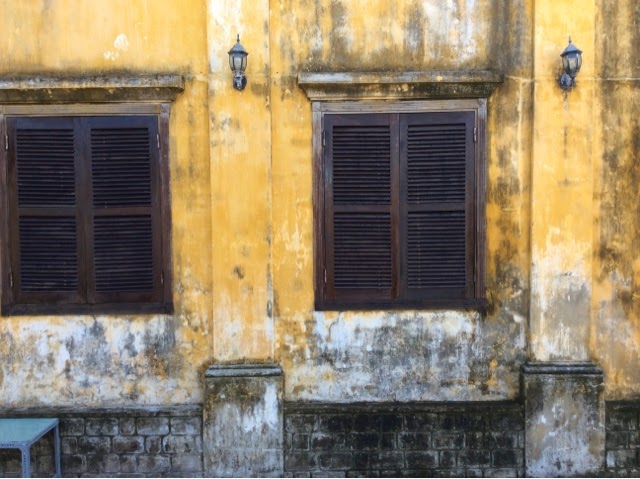
Trying to capture the sunrise on the old buildings, Blandy woke up with the birds and arrived with an hour to spare, so wandered the local markets.  Being the only foreigner, the locals interacted so differently than in the touristy area. They were slightly shy, until a low bow of the head and a big grin helped them feel at ease, and then usually there was a nod and grin back.


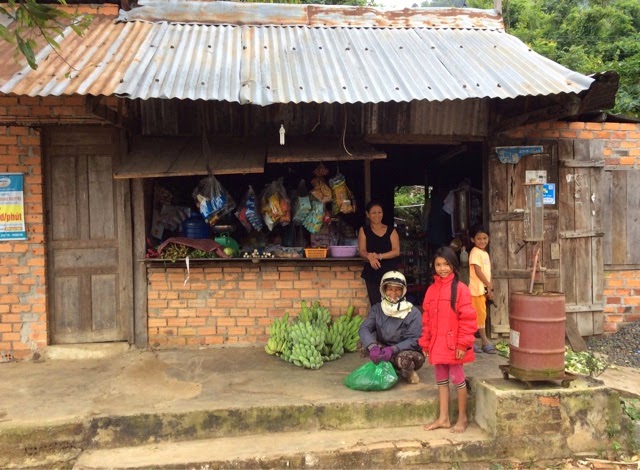
One smiley old cheeky nana called Chîn sat with her compadre Nga behind a massive haul of bananas.  They had six different kinds of bananas at their little market stand, and a strange bunch of green podded things, on a tufty frond that looked like it came off some sort of palm-ish type tree.  A cheery 'hello!' from the old nana started an hour long discussion and so many laughs!

Cheeky Chîn was 85 years old, asked if I was pregnant, I said no I am only pudgy, she had a laugh and asked if I had any babies.  When I replied no, she beckoned me to sit down next to her mate Nga, who was movie-star-handsome, smiley and 60ish... and Chîn lifted Nga's hand, and made him hold mine!  What a hoot!  Relishing the hilariousness of the moment and wanting to capture it, pulling out our iPad meant we had a session of photo taking, with all the neighbouring stall-holders coming to laugh and giggle with us.   A 40ish year old guy called Bobo came over from his shoe shop across the street and started chatting in English.  What a happy way to start the day, and it was still early enough to catch the sunrise!

Cheeky old Chîn pulled out a much-handled square tin.  And another little tin.  And another little container.  Being a curious lass I leant in a bit closer.  Chîn ceremoniously plucked, mixed, wrapped and stuffed a strange concoction in her mouth.  Bobo explained how cheeky old Chîn made her beetlenut paste.  She offered me some, and asked for Bobo to translate, he just said 'she wants you to have some but don't cos it makes your head crazy and you don't need that.'  Bobo said that the whole bunch of beetlenut frond would sell for 25 000 dong (about $1.50NZ).  Which means that the red-mouth and crazy head inducing experience is pretty accessible.  Bobo said only the old people are into it.


It's kind of hard to see but Nga has a left arm that's a bit different.  Probably a deformity caused by exposure to Agent Orange, we've read that there are second and third generation deformities from that terrible weapon, children today are still being born with a visible aftermath of the war in their bodies.


Here's Bobo below.  Dunno which type of animal he has in his hand.  But it could be any type of creature, and someone would eat it.  I winced and grimaced just looking at the thing, and slightly spewed in my mouth.  Bobo thought it was hilarious!


Back to nicer things ... here's one of the early morning photos I like the best.


On the way home, I heard tons of little voices and excited mayhem.  A lady with her three year old saw me looking through the gate to this kindergarten, and said 'This is my daughter's school, would you like to come and see?'  Course!  Mate ... life here is SO different.  10 classrooms in the kindergarten, 30 kids per class, 1 morning teacher, 1 afternoon teacher, kids do 7:30am till 4:30pm, with one sleep.  No thanks!  Tiny playground space, and no toys in the classrooms (just teacher-made life-like resources such as animals and household items, to instruct the kids with).  They didn't care one little bit if I took photos of the kids (being from NZ, I almost didn't ask, presuming that the answer would be 'not on your life!')  Funnily, the teacher got all the kids to do the peace sign, and say hello!


Have eaten some mini (and maxi!) feasts.  Pop in to Minh Heîn for a mean vegetarian feed, the White Rose dish is exceptional (and tricky to describe!)


Another exceptional gastronomical treat to prioritise in Hoi An is the passionfruit tart at Dingo Deli.  Flamin yum!  So much so, that in 24 hours we'd been there three times!  Michelle is the Aussie co-owner, full of smiles, helpful with travel ideas and great for a chat.  We should ask about getting those tarts shipped around the world ... they're worth their weight in platinum!


And that, ladies and gentlemen, was a long story to say that we loved Hoi An!


Tuesday, 21 October 2014

Ho Chi Minh Trail (Pleiku - Hoi An)


Our German mate Andreas (who we met yesterday while sheltering from the rain under a petrol station roof) had informed us that the road we were on was actually the Ho Chi Minh Highway.  Who knew?!  The only signs we'd seen said AH17, but in hindsight, maybe they're waiting for the road to be sealed before the revered leaders name will be plastered all over it.  I've got bets on the roadworks being finished in 2056.  

The road was a dream for the first 50km, and we passed Jan, a Dutch cyclist making his way from Bangkok to China, what a dude!  That may be our next adventure, if we can find a way to bungy-cord a couch onto the seat of a bicycle. 

The locals are quite good at strapping things on... This grandad probably wondered why I tailed him for ages, but I was trying to work out how to take photos on the iPad while riding along.  


The sleepy town of Dak To (pronounced Duck Toe) gave us our first peek at the minority peoples' tall-rooved buildings.  Just to the back of it we saw a couple of army tanks ... Our first 'in-place' reminder of that horrific war.  Reading that night, we learnt that Dak To was perhaps the most deadly and bloodied of all conflict in what the locals call the American War.  Thousands died fighting for possession of Hill 875 in the Dak To area.  The local plaques and descriptions tell of events from a perspective that we've not really been exposed to before.  The North went on to win the long-fought war, with the unified Vietnam becoming a communist state.  Multiple times we've ridden into a town, and the street has been lined with the red starred Vietnamese flag, interspersed with the red hammer and sickle flag.  Multiple locals have shared their view on politics in a very hushed manner, aware that the government's 'ears' are all about them.  How they'd love a chance to vote.


Our peaceful ride north had many corners that opened out into views like these hills.  Crazy to ride along imagining shells exploding all around, gunners opening fire, and tanks blitzing through the landscape.  And that was the Americans, the guerrilla warfare was all about surprise and luring the enemy into the jungle where the locals had the advantage.  It's mind-numbing to read about that part of history.  


Villages became pretty scarce, especially at the time we were both needing a wharepaku! Normally we'd be up for a behind-the-tree stop, but the book we're reading called 'A Short Ride in the Jungle:  The Ho Chi Minh Trail by Motorcycle' by Antonia Bolingbroke-Kent, speaks of up to 800 000 tons of UXO (unexploded ordnance) to this day remains live, and pollutes 15% of Vietnam's land surface.  Since 1975 more than 100 000 Vietnamese have been killed or injured by UXO and are still dying every week.  At present the Vietnamese government spend $100 million USD a year on clearing UXO, optimistically aiming to solve the problem within 100 years. That's a lot of information that impacts lives on many levels.  It also means we aren't gonna venture far off the obviously beaten tracks.  No squatting roadside for us!

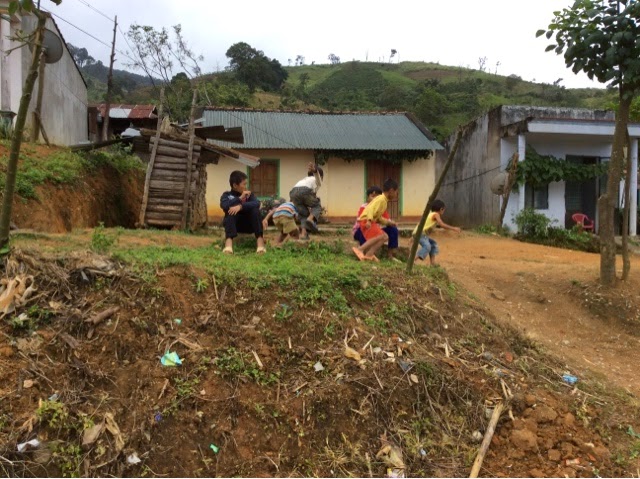
The most remote houses were made of sticks and mud, and had super happy kids that shouted out indecipherably happy words as they waved to us.  They were so unbelievably excited, and all crowded around when we stopped to cover our packs from the onset of drizzle.  The kids sprinted off as soon as the iPad came out though ... Here's the photo of the ones that were too slow to escape!


Riding within about 5km of the border with Loas, we rode into a chilled mist.  It seemed so apt.  That magnificently lush jungle was in its element!  I think I saw a new version of green too, so vibrant, yet dense.  For me it was the most stunning scenery of the ride so far.  Bry exhibited her best patience when I pulled over for a 106 photos, and the waterfall photo below may have been the limit, or, may have been fortuitous ... but a 'hurry up' order was given to me while in the middle of a two laned bridge, and ten seconds later a massive bus came hurtling around the corner as it overtook a large truck.  Both lanes were oversized.  Hmmm!  I inhaled quite suddenly, as if that extra inch may help (we need to create a sarcasm font!). It was pretty tight, and needless to say I took no more photos till we got into our hotel that night!


What a big ride! Pleiku to Hoi An, 330ish kms.  Took from 8:30am till 6pm, and through lots more roadworks.  That shower felt so refreshing, but even after a good scrub in the shower, an apology was needed to the hotel cleaner for how much grime still came off onto both of our towels (and dual sided too!).  Who designed white towels anyway?!


Sunday, 19 October 2014

Central highland bliss

Today was a day for giving thanks to the women responsible for front and rear suspension, and sports bras.  The road out of Da Lat was just like the road in to Da Lat, only more so.  This time, the pot-holes were shin deep in tepid, ochre puddles.  Try as you might to find a dry path between, sometimes the only thing for it is to hoist your feet up on the fuel tank, open the throttle, and hope for the best.  
Blandy came a cropper rather early in the piece.  (For those who may have placed a cheeky wager on Bry being the first to take a spill, you can kiss your filthy money goodbye).  This friendly guy (Juan, pictured) came out of his shed to thwack her foot peg back into place and offer a sticky green poultice for her second best knee (declined).


Aside from that hiccup, this was the perfect day.  Stunning vistas, beautiful skies, choice company.  For most of the ride, we were treated to a 360º panorama of bright green fields stretching way back to the mountains.


This is a massive coffee-growing region. Heaps of the houses had big tarps spread out in front with beans drying out in the sun. We stopped in and were allowed to take a closer look (and a little nibble).


Housing in the highlands is basic and beautiful.  Way up here you make do with what you've got on hand.  Usually lots of dirt, timber, corrugated iron, and a national flag. There mustn't be too many visitors up these ways, judging by the number of folks who came out to wave and shout Hello.


The strange contraption in the bottom left of this image is a common mode of transport. It has the sound (and pace) of a tractor, and it chugs along the open road towing a ginormous trailer-load of livestock or produce. The driver sits on the front of the trailer and steers with those elongated handlebars. If the corner is a sharp one he has to lean so far out to the side that he might as well just jump off.


Here's a shot of one being driven. It's a typical country-road scene round these parts.


But easily the pick of the dwellings were those that floated on the lake at Daklak. We saw maybe a dozen of these as we crossed over the bridge, and wondered what it would be like to grow up there, swimming over to your next door neighbour's to play, or chilling in the hammock on the back deck on a lazy Sunday.


This little 4-Square was a friendly place to stop and rest our saddle-weary cheeks. Everybody wants to have a chat at times like these. The fact that nobody understands each other makes little difference, except that the conversation is funnier and a bit more interesting.


Lunch was cooked up and served to us at one of the many little roadside shelters.  For 10,000 dong each (about 60 kiwi cents) a very smiley lady made us bean sprout omelettes, salad greens & rice paper for turning them into spring rolls, with the one of the tastiest little dipping sauces I think I've ever come across. (Don't worry, the shrimp one wasn't ours. As well as 'thank you' and 'sorry' we now also know how to say 'vegetarian'. And thanks to the influence of Buddhism in the region, we have no trouble sourcing a meal)


All in all, it was another excellent day. These views are the memories of Vietnam we'll definitely be taking away with us.